How laboratory vibrations impact LC-MS, GC and ICP analytical performance.
Summary
How vibration and table stability affect analytical performance
In analytical laboratories, accuracy and reproducibility are essential. Yet one critical factor is often overlooked: laboratory table stability.
Whether you are working with LC, MS, GC or ICP systems, your instrument performance depends not only on calibration and methods, but also on the physical environment. Even low-level vibrations can introduce noise, reduce sensitivity and compromise data quality.
Understanding and controlling this parameter is key to achieving reliable analytical results.
Analytical instruments are highly sensitive to environmental noise
In chromatography and mass spectrometry, data quality is directly linked to the signal-to-noise ratio (S/N). The lower the noise, the more precise and sensitive the measurement.
Scientific studies have demonstrated that:
- Detection limits are directly determined by signal-to-noise ratio
- Baseline noise significantly affects quantification accuracy and measurement uncertainty
This means that any external disturbance, including mechanical vibration, can degrade analytical performance.
Vibration in laboratories: a hidden source of analytical error
Vibration is one of the most underestimated sources of error in analytical laboratories. It can originate from multiple sources such as operator movement, HVAC systems, nearby instruments or building infrastructure.
However, one major and often overlooked source of vibration comes directly from auxiliary equipment, particularly chillers and pumps associated with analytical instruments.
Chillers and pumps: internal sources of vibration and noise
Most LC, GC and ICP systems rely on peripheral equipment such as vacuum pumps, cooling systems (chillers) and gas handling units. These components generate continuous mechanical activity that can directly impact the instrument.
Common issues include:
- Continuous low-frequency vibrations from compressors and pumps
- Micro-vibrations transmitted through tubing, cables or direct contact
- Acoustic noise contributing to signal disturbance in sensitive detectors
For example:
- LC-MS systems often use vacuum pumps that generate constant vibration cycles
- ICP systems rely on cooling systems (chillers) that introduce mechanical oscillations
- GC systems may include gas flow control systems that create subtle but continuous disturbances
Unlike external vibrations, these are internal and persistent, making them harder to detect and eliminate.
Impact of these vibrations on analytical performance
Vibrations generated by chillers and pumps can propagate through the laboratory setup and affect the instrument in several ways:
- Increased baseline noise
- Signal instability
- Drift in analytical measurements
- Reduced reproducibility
In some cases, these vibrations can directly affect sensitive components such as detectors, ion optics or plasma stability.
Even when instruments are correctly calibrated, these hidden disturbances can compromise performance.
Why laboratory table stability is critical
Your instrument is only as stable as the surface it sits on.
When vibration sources such as pumps or chillers are physically connected or located close to the instrument, the laboratory table becomes the primary pathway for vibration transfer.
Standard laboratory benches are NOT designed to
- Isolate vibrations generated by equipment
- Dampen continuous mechanical oscillations
- Prevent structural transmission
This is where dedicated solutions become essential.
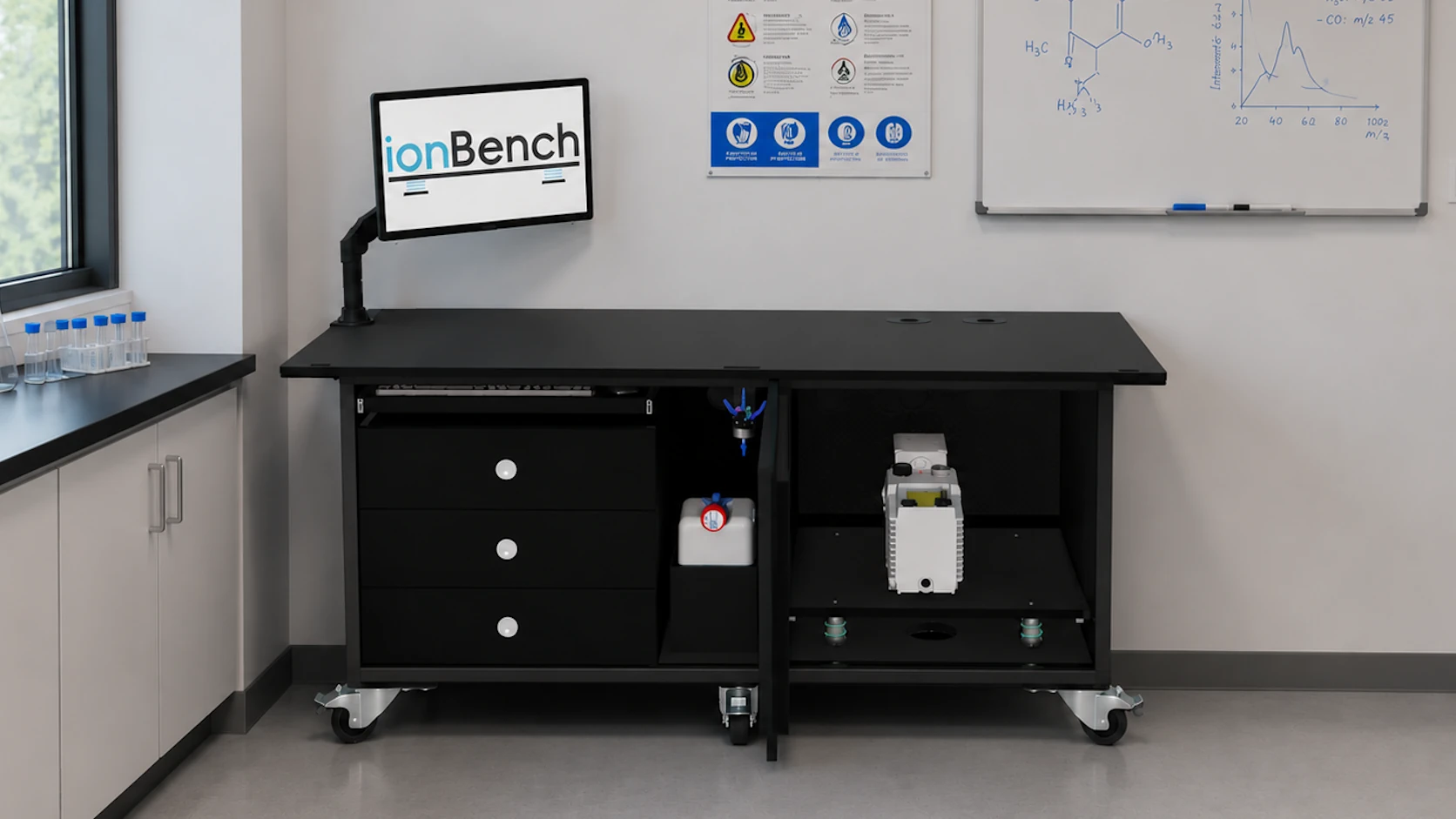
ionBench laboratory tables are specifically designed to address these challenges in analytical environments.
Their engineering focuses on:
- High structural rigidity to limit vibration propagation
- Materials selected for vibration damping
- Configurations that isolate instruments from auxiliary equipment
By reducing vibration transfer from both external and internal sources, they help stabilize analytical conditions and improve measurement reliability.
In this context, the laboratory table acts as a critical barrier between vibration sources and sensitive instrumentation.

How to identify vibration-related issues in your laboratory
Many laboratories experience performance issues without clearly identifying their origin. When chillers or pumps are involved, warning signs can include increased noise when auxiliary systems are running, signal fluctuations synchronized with pump cycles, variability depending on equipment activity or even improved results when these systems are temporarily stopped.
More generally, laboratories may observe poor reproducibility between runs, unstable calibration, elevated baseline noise or increased sensitivity to movement around the instrument.
These symptoms are often attributed to the analytical method or the instrument itself, while the actual root cause may in fact be mechanical vibrations transmitted through the laboratory environment.
Best practices to reduce vibration from chillers and pumps
Improving analytical performance requires controlling both external and internal vibration sources.
It is important to isolate auxiliary equipment whenever possible. Pumps and chillers should be positioned away from analytical instruments and direct mechanical contact with the instrument table should be avoided in order to limit vibration transfer.
Reducing vibration transmission is equally essential. Using flexible connections for tubing and cables helps minimize the propagation of mechanical vibrations, while avoiding rigid links that can transfer disturbances directly to sensitive instruments.
Using dedicated laboratory tables is also a key factor in improving analytical stability. Purpose-built tables designed for LC-MS, GC and ICP systems help absorb and isolate vibrations, including those generated by auxiliary equipment, creating a more stable environment for reliable analytical performance.
Conclusion
Vibration is not only an external problem. Chillers, pumps and other auxiliary systems are constant internal sources of disturbance in analytical laboratories.
Scientific evidence shows that these vibrations increase noise, reduce accuracy and can significantly impact measurement reliability.
By controlling these sources and using adapted laboratory tables such as ionBench solutions, laboratories can improve stability, reproducibility and overall analytical performance.



Let's work together
More than just a bench, we improve workplace comfort, safety and well-being. The most important thing is your health, so take care of yourself.
Our team responds to all inquiries within 24 hours and provides tailored solutions.
